
Best Natural Soap for Sensitive Skin: 2026 Guide
Table of Contents
- Why Your Skin Reacts: Understanding Sensitive Skin and the Skin Barrier
- What Makes the Best Natural Soap for Sensitive Skin
- Ingredients to Look For: Soothing, Moisturizing, and pH-Balanced
- Ingredients to Avoid for Sensitive Skin: Sulfates, Parabens, and Hidden Irritants
- How to Treat Sensitive Skin Naturally: Patch Testing, Water Hardness, and Bathing Habits
- Best Organic Body Scrub for Eczema: Choosing a Gentle Exfoliant
- How to Compare Natural Soaps Without Getting Fooled by Labels
- Frequently Asked Questions
Last Updated: September 28, 2026
Why Your Skin Reacts: Understanding Sensitive Skin and the Skin Barrier
The best natural soap for sensitive skin cleans without stripping your skin barrier, a distinction that matters more than any "gentle" claim on a label. Your skin barrier is the thin outer layer that holds moisture in and keeps irritants out; when it breaks down, everyday products sting.
Signs Your Skin Barrier Needs a Gentler Cleanser
Watch for these signals that your current soap is too harsh:
- Tightness or stinging within minutes of washing
- Redness that fades slowly, or lingers past an hour
- Flaking, rough patches, or a "squeaky clean" feeling that turns dry
- Itchiness that appears after bathing, not before
- Products that used to feel fine now burn on contact
What Makes the Best Natural Soap for Sensitive Skin
A soap earns the "best" label for sensitive skin when it cleans gently, keeps a skin-friendly pH, and leaves the barrier intact. Scent, lather, and packaging are secondary.
- pH balance. Traditional soap sits around pH 9-10. Skin prefers roughly pH 4.5-5.5. That gap matters for a compromised barrier.
- Surfactant type. Harsh surfactants strip oils fast. Gentler ones clean without the tight feeling.
- What stays behind. Glycerin, oils, and butters left in the bar act as emollients and humectants, helping skin hold water.
Cold-Process Soap vs. Syndet Bars: What the Label Won't Tell You
Cold-process soap is made by saponification, where oils and lye react to form soap and glycerin. Syndet bars use synthetic surfactants and can be formulated at a lower, skin-friendly pH.
Ingredients to Look For: Soothing, Moisturizing, and pH-Balanced
The ingredients that help sensitive skin fall into three jobs: soothe, moisturize, and support the barrier. Read the list looking for those functions, not buzzwords, a short list with recognizable names beats a long one with a dozen extracts, because every additional ingredient is another chance to react.
Soothing botanical extracts calm visible redness and itchiness:
- Calendula, long used for irritated skin; its flavonoids and triterpenoids are cited for calming visible redness.
- Chamomile, contains the anti-inflammatory compounds bisabolol and chamazulene. People with ragweed allergies should patch test, since chamomile is in the same plant family.
- Aloe vera, cooling and hydrating; the gel is mostly water plus polysaccharides that help skin hold moisture.
- Colloidal oatmeal, finely ground oat that the FDA recognizes as a skin protectant, one of the few "natural" ingredients with a regulatory designation behind it.
Moisturizing and emollient ingredients replace what cleansing removes:
- Shea butter, rich and occlusive; it sits on the surface and slows water loss rather than pulling water in.
- Goat milk, contains natural fats plus lactic acid, a mild alpha-hydroxy acid that can gently soften rough patches at low concentrations.
- Glycerin, a humectant that draws water into the skin. In cold-process soap it is a saponification byproduct that stays in the bar unless removed, a strong argument for cold-process over detergent bars that strip it out and sell it separately.
- Jojoba oil, technically a liquid wax. Its structure is close to human sebum, so it absorbs without a heavy film.
Barrier-supporting extras show up in better formulas:
- Vitamin E (tocopherol), an antioxidant that helps protect oils in the bar from going rancid and supports the skin's own lipid defenses.
- Botanical oils like olive, avocado, and sunflower, high in oleic and linoleic fatty acids that reinforce the lipid matrix between skin cells.
- Ceramides, not a soap ingredient in most bars, but they make up roughly half of the skin barrier. A soap cannot replace them, but one that does not strip them is doing its job.
Why pH Belongs in the Ingredient Conversation
pH is the single most measurable difference between a bar that soothes and one that irritates. Skin's acid mantle sits around pH 4.5 to 5.5, while traditional cold-process soap lands around pH 9 to 10, a four- to five-point gap.
How to Spot Ingredients Hiding Behind "Natural"
Label reading is where most buyers get tripped up:
- "Fragrance" or "parfum" is a legal catch-all that can contain dozens of undisclosed compounds, including phthalates used as fixatives. Under FDA labeling rules, individual fragrance components do not have to be listed.
- "Unscented" vs. "fragrance-free" are not the same claim. An unscented product can contain masking fragrance to cover the smell of raw ingredients. If your skin reacts to scent, look for fragrance-free.
- "Botanical fragrance" or "essential oil blend" sounds gentler than "fragrance" but is not automatically safer. Citrus, mint, lavender, and tea tree oils are common triggers on reactive skin.
- "Preservative-free" on a water-containing product is a red flag, not a selling point. Anything with water needs a preservative system, or it is a microbial risk.
For more detail on what manufacturers are and are not required to disclose, the FDA guidance on cosmetic labeling is the primary source.
Ingredients to Avoid for Sensitive Skin: Sulfates, Parabens, and Hidden Irritants
The ingredients to avoid for sensitive skin are the ones that strip oils, trigger reactions, or hide behind vague labeling. Some are obvious. Others are not.
- Sulfates such as sodium lauryl sulfate create big lather and strip skin fast
- Parabens are preservatives some users choose to avoid
- Phthalates often hide inside "fragrance" on a label
- Synthetic fragrance is a leading cause of contact irritation
- Essential oils are natural but not automatically safe; citrus and mint oils irritate reactive skin
- Alcohol in high amounts dries and stings
- Exfoliating beads or harsh scrubs in a daily bar cause micro-tears
How to Treat Sensitive Skin Naturally: Patch Testing, Water Hardness, and Bathing Habits
Treating sensitive skin naturally comes down to three habits: test before you commit, account for your water, and change how you bathe. Most people skip all three.
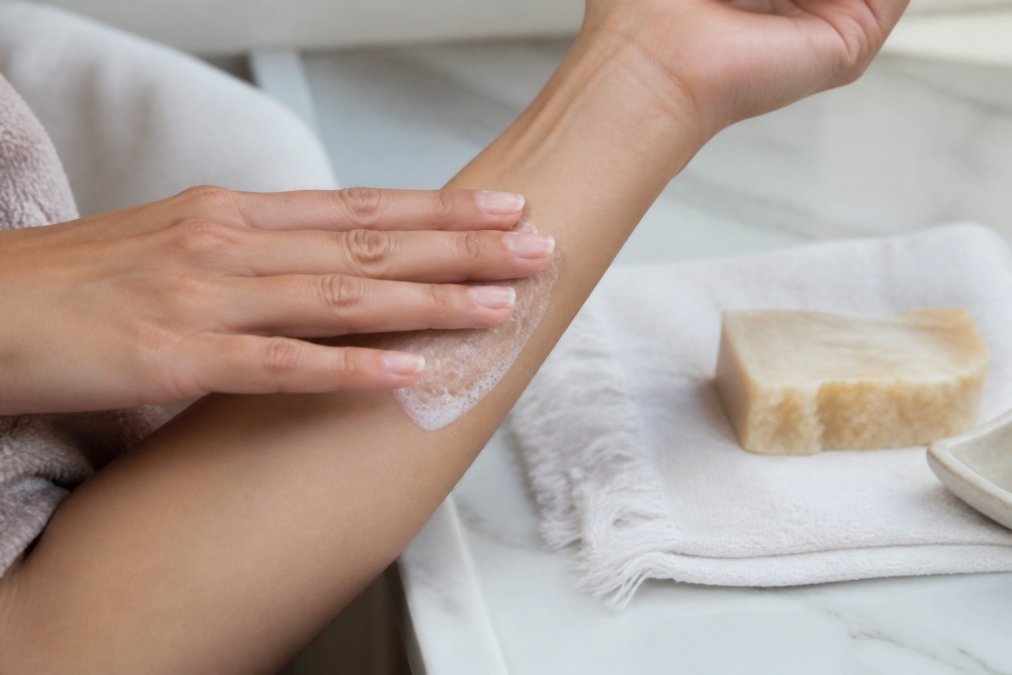
Bathing habits matter as much as product choice:
- Keep showers short and warm, not hot
- Use lukewarm water on the face
- Pat dry instead of rubbing
- Apply moisturizer within a few minutes of toweling off
- Wash with soap where you need it, not everywhere, every time
A Simple Patch Testing Protocol
Patch testing takes three days and prevents most bad reactions. Our protocol:
- Day 1: Wash a small area on your inner forearm with the new soap. Rinse and pat dry.
- Wait 24 hours. Check for redness, bumps, or itchiness at the site.
- Day 2: Repeat on the same spot if there was no reaction.
- Wait another 24 hours and check again.
- Day 3: If the area is still clear, test behind your ear, a thinner, more reactive patch of skin.
- Only then use the product on your face or body.
Best Organic Body Scrub for Eczema: Choosing a Gentle Exfoliant
The best organic body scrub for eczema exfoliates without scratching compromised skin. For eczema-prone skin, less friction is almost always better.
- Colloidal oatmeal as the exfoliant, which also soothes
- Fine sugar rather than coarse salt
- Soft jojoba beads that roll instead of cut
- A washcloth or soft brush instead of a scrub at all
How to Compare Natural Soaps Without Getting Fooled by Labels
Comparing natural soaps honestly means reading past the front of the package and checking four things: ingredient list, pH, fragrance status, and sourcing. Marketing copy tells you nothing useful.
| What to Check | Good Sign | Red Flag |
|---|---|---|
| Ingredient list | Short, recognizable names; full list published online | Long list, vague "fragrance," "proprietary blend" |
| pH | Stated value, or a low-pH syndet formula | No pH info, high-alkaline bar with no adjustment |
| Fragrance | Fragrance-free option offered | "Unscented" with masking scent |
| Sourcing | Transparent about where ingredients come from | No sourcing detail at all |
| Claims | Specific, testable statements | "Chemical-free" with no detail |
| Preservatives | Named preservative in water-based products | "Preservative-free" on a product containing water |
The pH Question Most Buyers Never Ask
pH is the single most useful number a soap maker can give you, and most do not publish it:
- Ask directly: "What is the pH of this bar?" A maker who knows their product can answer. A maker who cannot is guessing about the rest of the formula too.
- Understand the range: Skin sits around pH 4.5 to 5.5; traditional cold-process soap runs pH 9 to 10; syndet bars can be formulated lower. Neither is automatically better, but you should know which one you are buying.
- Test at home if you want to: pH strips are inexpensive. Dissolve a shaving of the bar in distilled water, let it settle, and dip the strip. Not lab-grade, but it tells you whether you are holding an alkaline bar or a near-neutral one.
- Watch for the word "balanced": "pH-balanced" without a number is marketing. "pH 5.5" is a claim you can evaluate.
How to Read a Label for Hidden Ingredients
Ingredient sourcing transparency is the gap most buyers never check. A maker who explains where ingredients come from and why usually understands formulation; one who hides behind "proprietary blend" does not.
A few label-reading rules:
- Order matters. Ingredients are listed by weight, highest first. If "fragrance" or an essential oil blend appears near the top, it is a significant part of the bar, not a trace.
- "Fragrance" is a legal umbrella. Under FDA labeling rules, individual fragrance components need not be disclosed, the single biggest blind spot on any label if you react to scent.
- "Unscented" is not "fragrance-free." Unscented can mean masking fragrance was added. Fragrance-free means no fragrance was added at all.
- "Chemical-free" is meaningless. Water is a chemical, and so is glycerin. That phrase signals marketing, not science.
- "Preservative-free" on a water-based product is a safety concern, not a virtue. Water-containing products need a preservative system to prevent microbial growth.
Questions to Ask Before You Buy
- What is the full ingredient list, including the fragrance components if any?
- What is the pH of the bar?
- Is it fragrance-free or unscented?
- Where are the oils and butters sourced from?
- Is there a preservative, and which one?
For more detail on reading labels, the FDA guidance on cosmetic labeling explains what manufacturers are and are not required to disclose.
Frequently Asked Questions
What is the healthiest soap to use on your skin?
The healthiest option for most people is a cold-process or syndet bar that lists its full ingredients and avoids sulfates, synthetic fragrance, and parabens. Look for moisturizing additions like glycerin, shea butter, or colloidal oatmeal, and check that the bar is pH-balanced rather than highly alkaline. If your skin is reactive, start with a fragrance-free formula and patch test before using it on your whole body.
Which ingredients should be avoided in soap for sensitive skin?
Skip sodium lauryl sulfate and sodium laureth sulfate, which strip the skin barrier. Avoid synthetic fragrance, parabens, phthalates, and formaldehyde-releasing preservatives. Also watch for essential oils like citrus, peppermint, and eucalyptus, which can irritate reactive skin even when marketed as natural. If you have eczema, steer clear of exfoliating beads or rough botanicals that create micro-tears and trigger flare-ups.
Is natural soap better for eczema-prone skin?
Natural soap can be gentler if it is truly free of harsh surfactants and synthetic fragrance, but the word natural alone does not guarantee safety. Some plant-based ingredients, including certain essential oils, still cause reactions. For eczema-prone skin, prioritize fragrance-free, pH-balanced bars with emollients like shea butter or oat extract, and follow with a thick moisturizer within three minutes of bathing to reduce transepidermal water loss.
How can I tell if a soap is truly natural?
Read the full ingredient list, not the front label. Truly natural bars typically list saponified oils (like olive, coconut, or shea), water, glycerin, and perhaps botanical extracts. If you see synthetic surfactants, artificial colors, or the word fragrance without qualification, it is not fully natural. Brands that share sourcing details and batch information are usually more transparent about what is actually in the bar.